Equipment and labs are housed in the Ball Communication Building, the David Letterman Communication and Media Building, and the Art and Journalism Building. All three buildings connect to create a communications complex.
Want to see the spaces in person? Select a Media Academic Appointment as part of your campus visit, or contact us to schedule a time.
Facilities
Ball Communication
Ball Communication Building (BC)
Ball Communication houses the Department of Media main offices, newly renovated Studios C, D, and E, University Media Services Equipment Checkout, our Podcast Studio, the Foley Studio, and the Betsy M. Ross Sports Link Studio.
Foley Studio
Media students regularly use the Foley Studio to create sound effects and foley sounds for their short films in a variety of classes.
Podcast Studio
The Podcast Studio is regularly used by student organizations to record podcasts, but students also reserve it to do voice over work. It’s a cozy space for podcast sessions, but spacious enough to set up cameras for video podcasting. The Podcast Studio includes a Zoom PodTrak P8 Multitrack Podcast Recorder, mics, and headphones. The Podcast Studio is used by production students of all skill levels.
Betsy M. Ross Sports Link Studio
Named after Ball State alumna and former ESPN SportsCenter anchor, Betsy M. Ross, the Sports Link Studio is used by sports production students to create content about and for Ball State Athletics. The space is used to shoot interviews, record podcasts, and produce programs like Inside the Chirp. This studio is used by sports production students of all skill levels.
Studio C
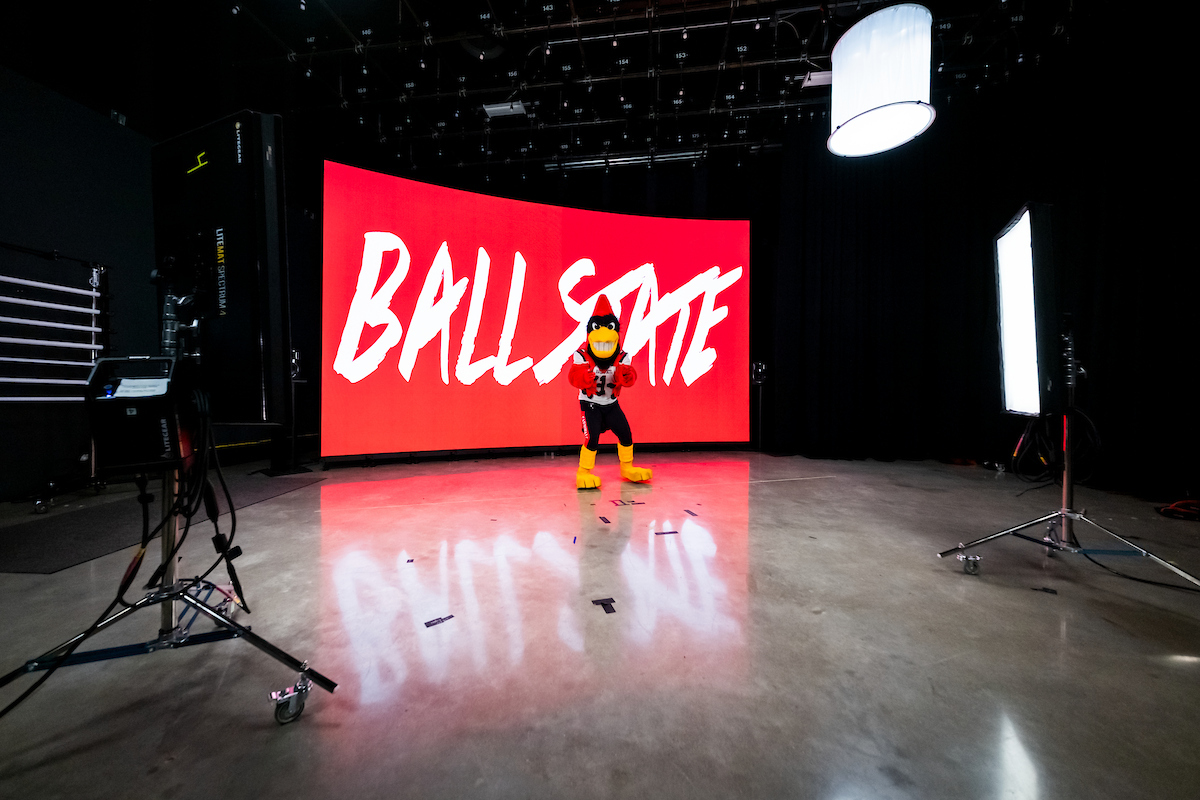
Studio C is home to our LED volume wall with professional space and floor lighting. Students use the LED volume to shoot short films, documentaries, sports content, and more. Unreal Engine and Blender 3D modeling software—along with our RED KOMODO 6K virtual production camera—allow students to shoot in front of 3D environments with camera tracking. Production classes regularly meet in Studio C, and the space is available for students to reserve after they’ve completed a virtual production course.
Studio D
Studio D, our most versatile studio, includes 40 LED light fixtures in the ceiling, a 2-wall white cyclorama, and a 20-foot floor to ceiling green screen. Studio D is also home to 2 Elation Fuze lights which are concert-style spotlights that can quietly project any color. Studio D is used by students to shoot interviews, music videos, shorts films, promotional videos, photography, sports content and more. Studio D is open to all production majors.
Studio E
Studio E is a simple to use 12’ x 12’ studio with a 2-wall green cyclorama and professional LED lighting fixtures. It uses the same lighting control system as Studios C and D. Students most often use this space to shoot small scenes, quick VFX shots, student organization content, interviews, and more. Studio E is open to all production majors.
Studios A and B
Managed by
University Media Services, Studios A and B and the accompanying control rooms serve the entire Ball State community. Student-produced programs like
SportsLink, Cardinal Sports Live, BSU Tonight, and
Cardinal Compass regularly use these state-of-the-art studios for productions featuring digitally-generated virtual sets, as well as traditional practical sets.
Ball State PBS broadcasts and immersive class projects also make use of the chroma-keyable green cycloramas in the spacious Studio A (over 40 feet wide), and the more modest Studio B (28 feet wide). Even more green is the full-LED lighting grid, which consumes a fraction of the energy needed for traditional tungsten lighting.
University Media Services Equipment Checkout
UMS Checkout houses the equipment production students need to produce content for their classes and student organizations. Students reserve what they need online and check it out here. Checkouts are available for 1 business day but may be renewed up to twice depending on availability. UMS Checkout also offers part-time student work. A summary of available equipment is at the end of this page.
Letterman Building
David Letterman Communication and Media Building (LB)
The Letterman Building is home to the Letterman Audio Studios and Surround Sound Editing Suites, the student-run WCRD 91.3 FM, and the Letterman Screening Room.
Letterman Audio Studios
Students use these studios to learn how to record, mix, and master music and sound for picture in stereo and surround sound.
WCRD Studio
The WCRD studios operate as an applied learning laboratory for Ball State students interested in media and radio. WCRD is a student–run radio FM station licensed by the Federal Communications Commission. It broadcasts at 91.3 FM and is accessible on the TuneIn and RadioFX apps. WCRD broadcasts a variety of music genres, talk shows, sports, news, and weather shows.
LB 121 SCREENING ROOM
Seating up to 30 people, this is a comfortable location to screen feature and short films for classes and other groups.
Surround Sound Editing Suites
These editing suites are open for all students to edit in 5.1 surround sound. Suites require swipe card permission for after-hours access.
Art and Journalism
Art and Journalism Building (AJ)
In the Art & Journalism Building, Media majors often spend time in the Unified Media Lab, Video News Studio, or the Control Room.
Unified Media Lab
The Unified Media Lab (UML) is the central hub for CCIM student-run news journalism organizations including the Ball State Daily News, Cardinal Sunrise, NewsLink Indiana, NewsLink Sports, Ball Bearings Magazine, and Byte.
Unified Media Lab Control Room
Students use the control room to produce content for NewsLink Indiana, Cardinal Sunrise, The Reel Deal, and other organizations. The control room uses industry-standard Ross Video equipment for production, graphics, live-streaming, and workflow.
Unified Media News Studio
Used by student groups like NewsLink Indiana, Cardinal Sunrise, and The Reel Deal, automated video production studio has live streaming capabilities with live field equipment, energy efficient LED and fluorescent lights to keep the studio cool, and an industry standard weather computer system.
Equipment
You’ll have access to standard gear your first year as part of a student organization and when you begin production courses. As your skill sets grow, so will your access to higher-level equipment. Below is some of the equipment Media majors have access to.
Cameras
- Blackmagic: BMPCC 4K and 6K
- Panasonic: LUMIX S5 II X
- RED: KOMODO 6K
- Sony: F5, FX3, FX6, and Z150
- Lenses: Anamorphic, cine, photo, probe
Audio
- Sennheiser 416 Boompole kits
- Condenser mics, on-camera mics, handheld mics, wired lavalier mics, and wireless mics
- Portable recorders: Sound Devices MixPre 10T, Sound Devices 702T, Zoom F6, Zoom H6-DOM, Zoom LiveTrak L-12 Mixer
Lighting
- Aputure: Amaran PT2c, Infinibars, LS 600c, LS 600d, LS D1200, MC 4-Light Travel Kit, Nova P600c and accessories
- ARRI SkyPanel S60-C
- Fiilex 3 Point Light Kits
- Litepanels: FRESNEL SOLA 6, and light panel kits
- Bescor LED and Genaray LED on-camera lights
- Accessories: C-stands, rolling stands, exposure tools, lighting modifiers, mini matth boom arms
Other Equipment
- Drones
- Dollies, gimbals, jibs, and sliders
- Field monitors, on-camera monitors
- Apple boxes, mounting hardware, slates